 English
  Polski
 Deutsch
 Čeština
 Slovenský
 Français
 Nederlands
Shopping Cart
Why are floor-to-ceiling bunk beds a revolution for small interiors?
Every square meter of floor space in a children's room is worth its weight in gold. That is where car races take place, intricate building block structures are engineered, and knightly battles are fought. Placing two traditional single beds on the floor often consumes over 4 square meters of space, leaving only a narrow walkway between the furniture and the desk. Squeezing the maximum out of vertical space is the only way to maintain ergonomics and freedom of movement.
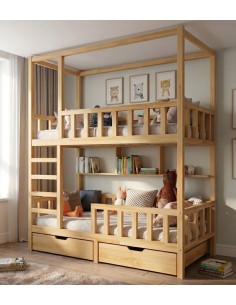
Floor-to-ceiling structures differ from standard chain-store furniture. First and foremost, they allow the bed to be perfectly integrated with the room's architecture. Thanks to this design, the bed not only becomes safer and more sturdy, but above all, it perfectly fills the space from the floor right up to the ceiling.
A panel-building apartment vs. a high-ceiling tenement house - case analysis
It is worth understanding that designing a high bed requires an individual approach depending on the type of building you live in:
| Building Type | Typical Ceiling Height | Design Challenges | Recommended Structural Solution |
|---|---|---|---|
| Apartment block / New development | 240 cm - 260 cm | Limited space above the top mattress, risk of bumping the head against the ceiling. | Precise lowering of the bottom tier, using low-profile (thinner) mattresses. |
| Tenement house | 280 cm - 350 cm+ | Challenge with the stability of very tall vertical posts, cooler air near the floor. | Utilizing extra space for tall staircase units with storage compartments, and the possibility to increase vertical clearance between bunks up to 120 cm. |
Floor-to-ceiling bunk beds vs. ergonomics and the 70-80 cm rule
One of the greatest concerns for parents is thermal comfort and breathing ease for the child sleeping on the top bunk. You have probably heard that warm air rises, which in a poorly designed interior can lead to a feeling of stuffiness. How can this be prevented? The key is the iron rule of ergonomics: maintaining 70-80 cm of clear space from the ceiling to the mattress surface.
Why is this range such an important factor?
- Freedom to sit up: A preschool or early school-age child sitting upright is approximately 60-70 cm tall (from buttocks to the top of the head). Maintaining a 70-80 cm clearance ensures that when waking up, your little one can comfortably sit on the bed without painfully hitting their head on the ceiling.
- Air circulation and microclimate: An adequate distance from the ceiling allows air to flow freely around the sleeping child. This prevents exhaled carbon dioxide and moisture from accumulating directly above the child's face, ensuring deep, restorative sleep.
- Parental comfort: When you need to check on a sick child, take their temperature, or simply read a bedtime story, this clearance will allow you to comfortably lean against the guardrails without bending your neck unnaturally.
Custom-made assembly - why do we use the "-25 mm" rule?
Mass-produced, ready-made furniture will never fit your room perfectly. If you are planning floor-to-ceiling built-ins, the bed must be made to the custom height of your ceiling. Due to material limitations, we use leg extensions for our beds. Therefore, for floor-to-ceiling heights, we choose a safe dimension of -25 mm so that assembly does not cause problems.
Where does this safety margin come from?
- Hassle-free vertical assembly: Large wooden structures are either assembled horizontally on the floor or put together standing up using ready-made modules. A 25 mm clearance allows for easy maneuvering of heavy elements, placing upper frames, and inserting connecting dowels without the risk of scratching a freshly painted ceiling. If you decide to install leg extensions on an already assembled bed, the 25 mm gap should ensure an effortless installation.
- Compensating for structural unevenness: Even in newly handed-over developer apartments, ceilings are rarely perfectly level across the entire floor area. A twenty-five-millimeter gap absorbs these micro-irregularities.
- Natural wood movement: Wood is a hygroscopic material that "breathes" - it subtly changes its volume depending on the season and indoor humidity (e.g., during the heating season). Leaving a -25 mm gap protects the structure from expansive stresses.
Safety first - how to choose bunk beds for the youngest?
Your child's safety is a parameter where there is no room for compromise. The fear that a toddler might roll off the top bunk during sleep keeps many moms and dads awake at night. By choosing a properly designed children's bunk bed, you are investing not only in ergonomics, but above all in peaceful sleep for the entire family.
Long front beam and safety features for younger children - ropes and protective netting
In the case of tall models, especially those with full enclosures or a roof, a crucial structural element is the additional long front beam at the entrance. It runs along the entire front of the top bunk, connecting the outer load-bearing posts and stabilizing the entire frame horizontally. It takes the greatest load when a child leans against the guardrails or when an adult helps change the bedding.
But what if a younger child (e.g., a 4- or 5-year-old) is to sleep on the top bunk, for whom a standard wooden guardrail seems insufficient? Modern, exceptionally durable safety systems come to the rescue:
- High-weave sailing / jute ropes: Used to weave between the guardrail and the upper ceiling frame, they create a flexible yet impenetrable wall. It is physically impossible for the child to fall out, and the piece of furniture itself gains a unique nautical or adventurous character. It is advisable to mount them in such a way that they can be easily detached when changing your child's bed linen.
- Polypropylene protective nets: Typically mounted on hooks from the top guardrails all the way to the ceiling. They are soft to the touch, do not hurt little hands, and at the same time withstand pressure of dozens of kilograms. This is an ideal choice for very active toddlers who wander across the entire mattress surface at night.
Solid construction and flawless pine wood - the foundation of durability
An absolutely unrivaled material in the production of children's furniture is natural wood. Cheap MDF or HDF particle boards, glued using formaldehyde resins, quickly lose their rigidity under such high dynamic loads and tall structures. Wood is a classic that combines high elasticity, antistatic properties (it does not attract dust - which is crucial for little allergy sufferers), and exceptional mechanical strength.
However, pay special attention to the grade of the chosen raw material. Professional wooden bunk beds should be made exclusively from carefully selected first-grade wood. What does this mean in practice?
Remember as a parent: Top-quality pine wood for a child's room must be completely free of blemishes, resin pockets, and knots. Why is this so important? Knots are actually dead pieces of branches inside the trunk - over time they dry out, shrink, and can fall out, weakening the bed frame's structure. On the other hand, resin pockets can "weep" after years under the influence of household heat, releasing sticky resin that discolors eco-friendly water-based paints, ruins the furniture's aesthetics, and can even permanently stain mattresses. By choosing knot-free wood, you are guaranteed that the bed will remain in pristine condition for decades.
Ladder or stairs? Which bunk beds will work best in your home?
When designing a sleeping zone for siblings, you will face a dilemma: how should the child access the top bunk? Two main solutions dominate the market, and the choice between them should be dictated by the children's age and the available floor space.
Bunk beds with stairs - comfort, drawers, and safe climbing
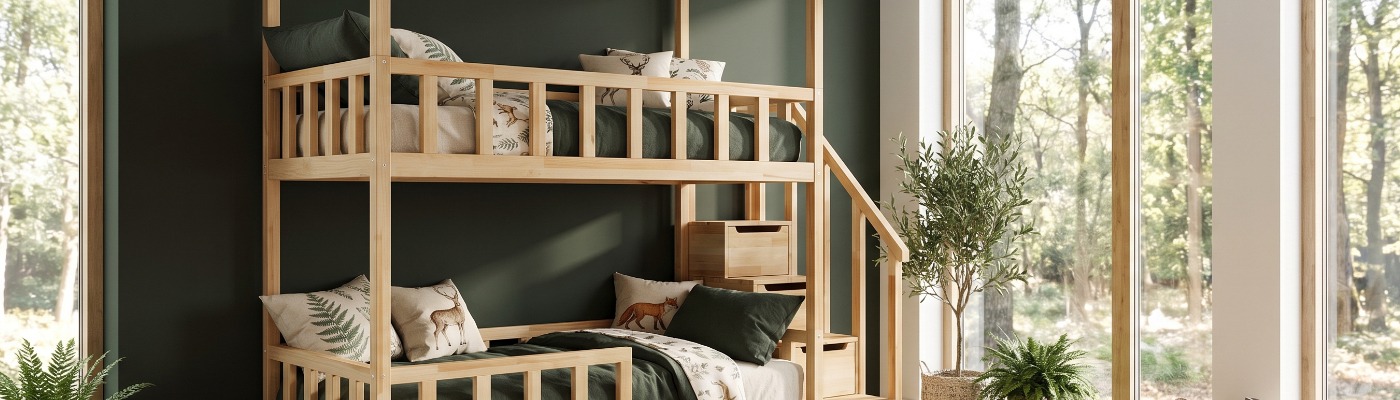
For younger children, as well as for parents who value maximum peace of mind, bunk beds with stairs are an unrivaled solution. The staircase is an autonomous, deep structure placed on the side or front of the bed, offering a number of unique benefits:
- Secure, solid construction: The child places their entire foot on a wide, stable step, completely eliminating the painful pressing of narrow rungs into delicate soles of hands and feet.
- Safety going up and down: The stairs are equipped with a dedicated handrail. Even a sleepy toddler climbing up in the middle of the night has a solid support point. If you install the stairs against a wall, you can forgo the handrail; however, we recommend keeping it if space allows, to support your child when getting in and out of bed.
- Brilliant storage system - drawers in the steps: Each step of the staircase is actually a drawer on runners with a depth of 25 cm. This is a fantastic space saver! You gain from 4 to 5 storage compartments where you can unobtrusively hide toys, board games, child's underwear, or books, thereby taking the load off the room's wardrobes.
Classic ladders in a modern edition
If your child's room is extremely narrow and you cannot afford to add several dozen centimeters for a staircase structure, a classic ladder will be the right choice. Remember to choose an appropriate ladder for your child so that the spacing of the rungs does not cause problems when climbing in and out of bed. Here, too, pay attention to the rung ends - they should be beveled so that the child does not come into contact with sharp edges.
Long-term functionality - house-style bunk beds and under-bed drawers
To make the most of every centimeter of space, modern bunk beds offer thoughtful storage systems that can easily replace an extra chest of drawers. By buying custom-made furniture, you don't have to limit yourself solely to the sleeping function - you can create a comprehensive interior system.
House-style bunk beds - a creative space for play
Children do not view furniture solely in functional terms. To them, a bed is a pirate ship, a princess castle, or a secret base. House-style bunk beds are an absolute design hit that perfectly combines the psychological need to have one's own "sanctuary" with functionality.
It is also worth remembering that with a roof structure, similar safety features can be applied as with floor-to-ceiling beds. Thanks to this, the canopy is not only an aesthetic accessory, but above all, it can turn into additional protection for your child. The biggest drawback of this design, however, is that the child may outgrow or get bored of it after a few years, requiring the canopy to be removed.
Wooden children's bunk beds with drawers - maximum space saving
The space between the bottom mattress and the floor (the under-bed clearance) is wasted space in standard beds where only dust collects. When choosing wooden bunk beds for children, make sure to opt for a model equipped with spacious bottom drawers.
How to design this element to be as practical as possible?
- Two independent drawers vs. one giant one: Two smaller drawers are much easier for a child to pull out daily than a single heavy box spanning the entire length of the bed (which, when loaded with bedding, can weigh several dozen kilograms). Furthermore, such a layout allows you to create separate storage spaces for both little ones.
- Rubberized caster wheels: Make sure the drawers roll on non-marking wheels that do not scratch the floor (e.g., made with rubber or silicone). This way, you will avoid damaging laminate panels or parquet floors after a few months of use. Avoid drawers on runners. Because such drawers are often heavily loaded, metal runners can quickly bend and get damaged.
- Third sleep function: If your children often host sleepovers for friends or cousins, the bottom drawer can be adapted to serve as a pull-out floor-level bed. By choosing a mattress-ready drawer available in our store, you get a practical bottom bed that is perfect as an extra sleeping space. Note that in the standard version, the mattress height cannot exceed 10 cm.
Practical Parent's Guide: Arrangement tips for a room with a floor-to-ceiling bed
Before making your final decision on the furniture configuration, we have prepared a summary of the most important interior design best practices in the form of a clear checklist. These details determine your children's daily comfort.
Shopping and assembly checklist for the conscious parent:
- ☐ Precise three-point measurement: When measuring ceiling height, do it in at least three different spots along the wall where the bed will stand. Provide the smallest dimension obtained (remembering to subtract the -25 mm).
- ☐ Lighting on the top bunk: Avoid hanging central ceiling lights with harsh glare directly above the top bunk. Instead, plan for a cozy LED wall sconce or a safe, warm-toned LED strip with a switch within the child's reach near the top mattress.
- ☐ Matching the mattress to guardrail height: Remember that safety guardrail height is measured from the top edge of the mattress, not from the bed frame base! If the guardrail is 33 cm high, buying a very thick, 20 cm mattress will leave the child with only 13 cm of real protection. Choose ergonomic mattresses 10-14 cm thick.
- ☐ Air circulation and ventilation: Make sure there is a sturdy slatted base made of flexible slats under the mattresses. A mattress must never rest on a solid board - it needs to breathe from underneath to prevent mite and mold growth. In our beds, the slatted frame is included in the set.
- ☐ Protecting walls from dirt: Children sleeping against a wall often touch it with their feet or hands while sleeping. It is worth installing an extra protective barrier along the long sides of the bed to protect paint or wallpaper from rubbing off. In beds produced by us, you will find a protective guardrail along all wall-facing sides.
Summary - safe sleep and gained space in a child's room
Investing in a floor-to-ceiling bunk bed is a strategic decision that can completely transform the dynamics of a children's room. It is an ideal choice, especially with younger children. By utilizing vertical space, you gain a piece of furniture perfectly integrated into the interior that does not overwhelm, but rather organizes the space. Ensuring an ergonomic 70-80 cm clearance from the ceiling, choosing first-grade pine wood free of blemishes, knots, and resin, and opting for stable constructions with stairs and additional safety ropes gives you 100% certainty that your children are safe.
You no longer have to choose between comfortable sleep for siblings and free floor space for unrestricted play. Thoughtful storage systems hidden in the stair steps and spacious bottom drawers will make keeping your little ones' room tidy easier than ever.
Ready for a change in your child's room? Check out our offer of knot-free, fully safe natural wood furniture, explore available solutions in our store, and let us create a bed tailored perfectly to your room's dimensions and your family's dreams!